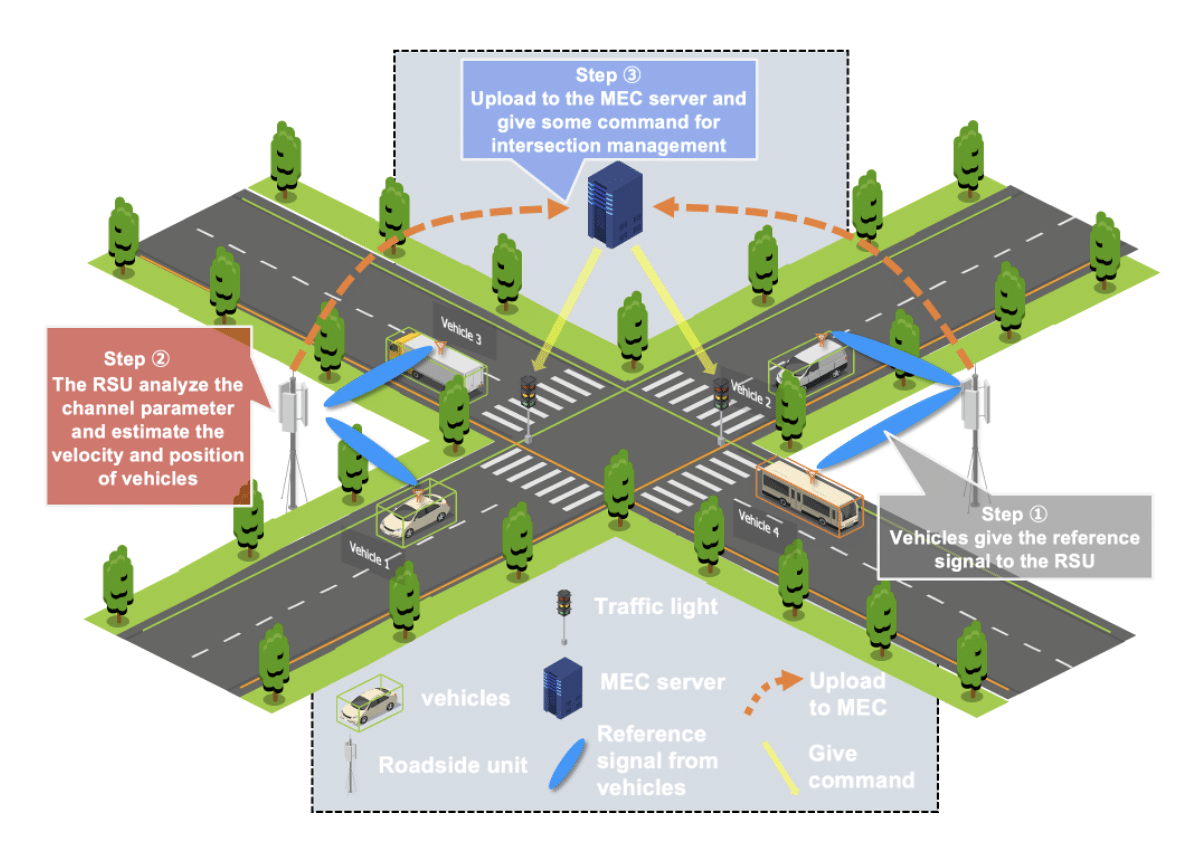
As autonomous driving and intelligent transportation systems (ITS) rapidly evolve, accurate vehicle localization has become a fundamental pillar for cooperative mobility and Vehicle-to-Everything (V2X) communications. While traditional GPS provides adequate positioning in open areas, its reliability drastically degrades in urban canyons, tunnels, and other non-line-of-sight (NLoS) environments. To address these limitations, our research project proposes a unified, GPS-free vehicular localization framework that leverages the rich physical-layer information of Beyond 5G/6G wireless communication channels. By integrating sensing and communication, this scalable infrastructure-assisted solution maintains high precision across blockage, high-mobility, and dense multi-user conditions.
For line-of-sight (LoS) environments, the project introduces a continuous tracking architecture based on millimeter-wave (mmWave) multi-antenna systems. We developed an adaptive, low-complexity 2D-MUSIC algorithm that efficiently extracts highly precise Direction-of-Arrival (DoA) and Time-of-Arrival (ToA) information. To overcome the instantaneous nature of geometric estimates, these spatial parameters are organically fused with vehicle motion dynamics using an Unscented Kalman Filter (UKF). This tightly coupled MUSIC-UKF approach effectively mitigates measurement noise and error accumulation, enabling stable, real-time trajectory and velocity estimation that is highly adaptable to complex road geometries like curves and intersections.
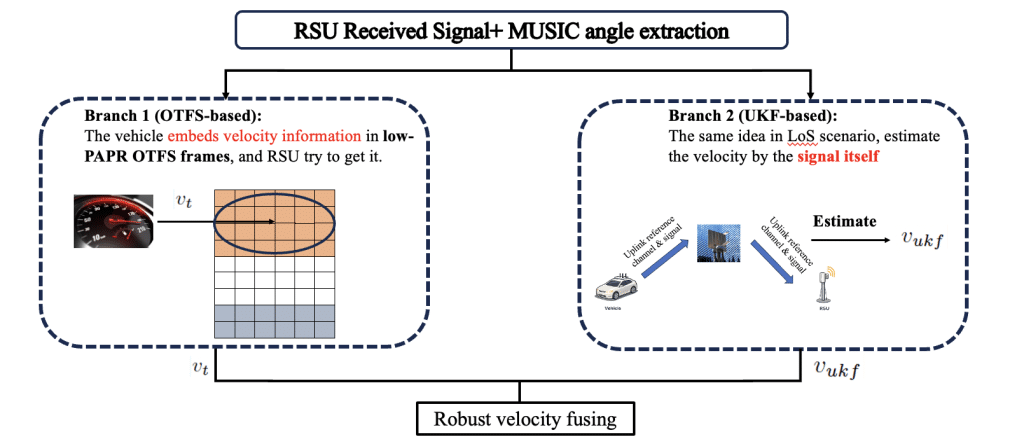
When direct LoS paths are obstructed, angle-based localization conventionally fails. To conquer this challenge, the framework transitions to an advanced sensing strategy integrating Reconfigurable Intelligent Surfaces (RIS) and Orthogonal Time Frequency Space (OTFS) modulation. The strategically deployed RIS reconstructs controllable virtual propagation paths around obstacles, restoring channel observability. Concurrently, the OTFS modulation, enhanced by a novel low Peak-to-Average Power Ratio (PAPR) pilot design, expertly resolves severe Doppler shifts and multipath fading typical of high-speed vehicular mobility. A dual-branch velocity estimation method utilizing the UKF further guarantees tracking resilience under these harsh NLoS conditions.
Finally, to ensure scalability for dense, real-world traffic scenarios, the framework is extended to support multi-user coexistence. It features an interference-aware iterative successive interference cancellation (SIC) scheme based on a page-style frame structure to efficiently separate overlapping user signals. Additionally, it employs an adaptive DoA estimation mechanism that dynamically selects the optimal processing mode—switching between Root-MUSIC for low-noise conditions and Forward-Backward Spatial Smoothing (FBSS) for high-interference regimes. Ultimately, this comprehensive research bridges classical array-signal processing with cutting-edge waveform design, laying a robust and reliable foundation for the cooperative perception required by future autonomous mobility networks.
@phdthesis{Hu2025,
title = {Reliable GPS-Free Vehicle Localization for V2X Systems: A Study across Blockage, High-Mobility, and Multi-User Conditions},
author = {Dou Hu},
year = {2026},
date = {2026-03-31},
urldate = {2026-03-31},
school = {Ph.D Thesis, The University of Tokyo},
abstract = {Accurate vehicle localization and velocity estimation is a fundamental requirement for intelligent transportation systems, autonomous mobility, and safety-critical V2X communication. However, achieving reliable positioning in realistic vehicular environments remains challenging, as signal propagation continuously transitions between line-of-sight (LoS) and non-line-of-sight (NLOS) conditions, while Doppler dynamics, fast mobility, and multipath fading disrupt classical localization strategies. To address these challenges, this dissertation presents a unified and channel-adaptive localization framework that maintains reliable positioning performance across heterogeneous V2X scenarios. For LoS environments, a low-complexity 2D MUSIC-based direction-of-arrival estimator is developed to extract azimuth and elevation information from mmWave antenna arrays. The estimated angles are fused with kinematic motion states using an Unscented Kalman Filter (UKF), enabling continuous trajectory estimation with high temporal stability and robustness against measurement noise. This module demonstrates centimeter-level accuracy while significantly reducing computational overhead compared with exhaustive spectral search-based approaches. When LoS paths disappear and angle-based localization becomes unreliable, the framework transitions to a sensing strategy built on Orthogonal Time-Frequency Space (OTFS) modulation. A reconfigurable intelligent surface (RIS) is incorporated to reconstruct controllable propagation paths and enhance channel observability in NLoS conditions. A structured delay-Doppler processing and velocity estimation method are further designed to ensure delay, Doppler, and channel coefficient resolvability under high mobility and sparse multipath conditions. The final stage extends the methodology to multi-user environments. An interference-aware iterative SIC-based page-style method is introduced to separate overlapping user signals. Furthermore, we also give the idea for adopting different MUSIC algorithms under different SNR between an adaptive FBSS and Root-MUSIC-enhanced estimator, the method dynamically selects processing modes based on interference level and snapshot quality. This enables scalable localization without sacrificing precision under dense vehicular access. Comprehensive simulations confirm the effectiveness of the proposed system under different mobility levels, SNR conditions, antenna geometries, waveform configurations, and user densities. Results demonstrate that the framework achieves sub-degree DoA estimation accuracy in LoS conditions, maintains reliable localization performance under severe NLoS environments with RIS assistance, and supports multi-user coexistence with predictable computational complexity. Overall, this dissertation presents a scalable, robust, and environment-adaptive localization framework that bridges classical array-signal processing, OTFS waveform design, and RIS-assisted channel engineering. The proposed methodology serves as a promising foundation for next-generation autonomous mobility, cooperative perception, and future V2X communication systems.},
keywords = {},
pubstate = {published},
tppubtype = {phdthesis}
}
@misc{Hu2026,
title = {Robust Vehicle Localization Based on Adaptive DOA Estimation and UKF under Varying Interference Conditions},
author = {Dou Hu and Pengfei Lin and Manabu Tsukada
},
doi = {10.1109/CCNC65079.2026.11366311},
year = {2026},
date = {2026-01-09},
urldate = {2026-01-09},
abstract = {Only the chairs can edit Accurate vehicle localization in GPS-denied environments is essential for enabling future intelligent transportation systems (ITS) and vehicular networks. Direction-of-arrival (DOA) estimation techniques such as MUSIC and Root-MUSIC provide high-resolution localization but their performance depends heavily on the interference environment. In particular, Root-MUSIC achieves superior accuracy under clean line-of-sight (LoS) conditions, whereas forward-backward spatial smoothing (FBSS) enhances robustness against multipath and interference. To address the limitations of fixed estimators, this paper proposes an adaptive DOA-based localization framework for GPS-denied scenarios. The framework dynamically selects the optimal estimator according to interference levels: Root-MUSIC with an Unscented Kalman Filter (UKF) is employed under low-interference conditions, while FBSS-Root-MUSIC with UKF is adopted in the presence of strong interference. Simulation results show that the proposed method consistently outperforms static approaches, reducing positioning error across varying SNR and interference regimes. This adaptability makes it a reliable solution for vehicle localization in non-stationary wireless environments without GPS support.},
howpublished = {IEEE Consumer Communications & Networking Conference (CCNC2026), Poster},
keywords = {},
pubstate = {published},
tppubtype = {misc}
}
@article{Hu2025c,
title = {DoA Estimation and Kalman Filter based Multi-Antenna System for Vehicle Position in mmWave Network},
author = {Dou Hu and Jin Nakazato and Javanmardi Ehsan and Kazuki Maruta and Rui Dinis and Manabu Tsukada},
doi = {10.1109/OJVT.2025.3608747},
issn = {2644-1330},
year = {2025},
date = {2025-09-14},
urldate = {2025-09-14},
journal = {IEEE Open Journal of Vehicular Technology},
volume = {6},
pages = {2761-2775},
abstract = {With the advancement of Beyond 5G/6G technologies, accurate positioning and velocity estimation in Internet of Vehicles (IoV) systems has become increasingly critical. Although GPS can provide real-time location information, its performance degrades significantly in environments with heavy obstructions, such as urban areas surrounded by skyscrapers. To address this limitation, this study proposes a positioning framework that relies on channel parameter estimation derived from multi-antenna signal processing. Specifically, we adopt an adaptive low-complexity 2D MUSIC (ALC2D-MUSIC) algorithm to estimate signal directions, and further apply an unscented Kalman filter (UKF) using extracted Direction of Arrival (DoA) and Time of Arrival (ToA) information to estimate vehicle positions and velocities. The proposed system is robust to variations in road geometry, making it suitable for deployment in diverse traffic environments. Simulation results demonstrate that our method achieves high estimation accuracy and outperforms a compressive sensing-based approach across different SNR levels, angular search resolutions, and antenna array sizes. Furthermore, the UKF-based tracking algorithm shows superior performance in curved road scenarios, validating its effectiveness under realistic mobility conditions.},
keywords = {},
pubstate = {published},
tppubtype = {article}
}
@article{Hu2025b,
title = {OTFS Based RIS-assisted vehicle positioning and tracking in V2X scenario},
author = {Dou Hu and Jin Nakazato and Kazuki Maruta and Rui Dinis and Omid Abbassi Aghda and and Manabu Tsukada},
doi = {10.1109/TCOMM.2025.3588559},
issn = {0090-6778},
year = {2025},
date = {2025-07-08},
urldate = {2025-07-08},
journal = {IEEE Transactions on Communications},
volume = {73},
issue = {11},
pages = {10676-10691},
abstract = {This paper proposes a novel and robust framework for velocity and position estimation in vehicle-to-everything (V2X) communication networks, targeting challenges that arise when traditional GPS systems and line-of-sight (LoS) channels fail due to signal blockages between vehicles, base stations (BSs), and satellites. The proposed solution integrates multiple complementary methods to enhance robustness and accuracy. Specifically, the framework first applies the MUSIC algorithm for angle-of-arrival (AoA) estimation to obtain reliable initial positioning. In parallel, a newly designed low peak-to-average power ratio (PAPR) frame structure is introduced under reconfigurable intelligent surface (RIS)-assisted Orthogonal Time Frequency Space (OTFS) modulation, enabling resilient velocity embedding against noise and interference. These methods jointly support an unscented Kalman Filter (UKF), which refines the velocity and position estimation with high reliability. Extensive numerical evaluations confirm the effectiveness of the proposed multi-method integrated framework. Various modulation techniques, including zero padding (ZP), cyclic prefix (CP), and their recursive variants (e.g., RZP, RCP), demonstrate improved bit error rate (BER) performance over traditional OFDM. The proposed low-PAPR signal design achieves a 21.5% PAPR reduction compared to conventional embedded pilot schemes, significantly improving BER in 4-QAM scenarios. Velocity estimation results also show that the UKF outperforms the extended Kalman Filter (EKF) in both straight and curved road conditions. By combining MUSIC-based AoA estimation with RIS assistance under NLoS conditions, the proposed framework remains effective even in high-Doppler and low-SNR environments.},
keywords = {},
pubstate = {published},
tppubtype = {article}
}
@workshop{Hu2025,
title = {A Low PAPR Layered Multi-User OTFS Modulation},
author = {Dou Hu and Jin Nakazato and Kazuki Maruta and Omid Abbassi Aghda and Rui Dinis and Manabu Tsukada},
year = {2025},
date = {2025-06-17},
urldate = {2025-06-17},
booktitle = {AI-Driven Connectivity for Vehicular and Wireless Networks in VTC2025-Spring},
address = {Oslo, Norway},
abstract = {In modern communication systems, meeting the growing demand for high-capacity transmission requires developing efficient and robust modulation techniques. To address this, we propose a low-PAPR page-style Orthogonal Time Frequency Space (OTFS) modulation framework that enhances communication capacity while maintaining a low peak-to-average power ratio (PAPR). The proposed design introduces a novel pilot signal placement and analysis method, improving channel estimation accuracy and system performance in high-mobility multi-user scenarios. This paper provides an overview of recent advancements in OTFS-based multi-user communication systems, emphasizing their contributions to enhancing spectral efficiency, reliability, and robustness. Through extensive simulations, we demonstrate the effectiveness of the proposed framework in achieving superior BER performance, improved interference mitigation, and robust transmission capabilities compared to traditional methods, validating its suitability for next-generation communication networks.},
howpublished = {Workshop on AI-Driven Connectivity for Vehicular and Wireless Networks in VTC2025-Spring},
note = {IEEE VTS Tokyo/Japan Chapter 2025 Young Researcher's Encouragement Award},
keywords = {},
pubstate = {published},
tppubtype = {workshop}
}
@workshop{Hu2024,
title = {A Research of Kalman Filter enabled Beam Tracking for Multiple Vehicles},
author = {Dou Hu and Jin Nakazato and Ehsan Javanmardi and Muhammad Asad and Maruta Kazuki and Manabu Tsukada},
url = {https://www.ieice.org/publications/proceedings/bin/pdf_link.php?fname=15.pdf&iconf=ASPIRE_WS&year=2024&vol=80&number=P-15&lang=E?.pdf},
doi = {10.34385/proc.80.P-15},
isbn = {2188-5079},
year = {2024},
date = {2024-03-05},
urldate = {2024-03-05},
booktitle = {ASPIRE Workshop 2024 in conjunction with the IEICE General Conference},
address = {Hiroshima, Japan},
abstract = {In the era of Beyond 5G, the significance of interdisciplinary research has become increasingly important. Within this context, the Kalman filter, a technology integral to self-positioning estimation in autonomous driving, is already being adopted in various societal applications. This study proposes a method wherein beam tracking, in conjunction with the Kalman filter, is an alternative to GPS in specific scenarios. This research is particularly relevant in environments such as intersections flanked by high-rise buildings, where GPS signals are prone to interference.
},
keywords = {},
pubstate = {published},
tppubtype = {workshop}
}
@conference{Dou2023,
title = {Extended Kalman filter based beam tracking for vehicle position and velocity estimation under intersection scenario},
author = {Dou Hu and Jin Nakazato and Ehsan Javanmardi and Muhammad Asad and Manabu Tsukada and Kazuki Maruta
},
year = {2023},
date = {2023-10-10},
urldate = {2023-10-10},
booktitle = {革新的無線通信技術に関する横断型研究会(MIKA)},
address = {沖縄県},
abstract = {As typified by the IoT, mobile traffic continues to increase with the spread of devices equipped with wireless communication functions. Deploying small cell base stations (BSs) is known to straight forward way to efficiently support such traffic. Meanwhile, the facility cost increases when large numbers of BSs are deployed in a fixed manner. It is possible to construct an efficient wireless network by installing BS functions in moving objects such as vehicles and UAVs, and allowing them to move autonomously or activate wireless functions to follow the traffic demand. This paper proposes a method for estimating propagation channels and vehicle position/velocity information at intersections based on vehicle-oriented beam control using a Kalman filter.},
keywords = {},
pubstate = {published},
tppubtype = {conference}
}
@misc{Hu2023,
title = {An Extended Kalman Filter Enabled Beam Tracking Framework in Intersection Management},
author = {Dou Hu and Jin Nakazato and Ehsan Javanmardi and Muhammad Asad and Manabu Tsukada
},
url = {https://www.researchgate.net/profile/Jin-Nakazato/publication/371358188_An_Extended_Kalman_Filter_Enabled_Beam_Tracking_Framework_in_Intersection_Management/links/64807e24b3dfd73b776baeed/An-Extended-Kalman-Filter-Enabled-Beam-Tracking-Framework-in-Intersection-Management.pdf},
year = {2023},
date = {2023-06-06},
urldate = {2023-06-06},
address = {Gothenburg, Sweden},
abstract = {Recently, vehicle-to-everything (V2X) has been at- tracting attention for its potential to improve traffic safety and increase traffic volume worldwide, improving the accuracy of data and parameters collected from moving vehicles is widely discussed in the V2X. The most common technique of GPS may not be efficient during some specific scenarios, like some intersections full of skyscrapers, or some special terrains with obstacles. In such cases, GPS technology has a longer detection period and lower tracking accuracy, so beam tracking can be a fast and efficient solution in these circumstances. Therefore we propose an anti-diverge extend Kalman filter-enabled beam tracking method in V2X to help the intersection management. The numerical results show that our method has the ability to resist the Kalman filter’s divergence and can detect data in an accurate manner.},
howpublished = {European Conference on Networks and Communications (EuCNC) & 6G Summit Poster},
keywords = {},
pubstate = {published},
tppubtype = {misc}
}
v2x
digital twins extended reality
digital twins
autonomous driving machine learning
machine learning v2x
autonomous driving v2x
extended reality
v2x
We are part of the University of Tokyo’s Graduate School of Information Science and Technology, Department of Creative Informatics and focuses on computer networks and cyber-physical systems
Address
4F, I-REF building, Graduate School of Information Science and Technology, The University of Tokyo, 1-1-1, Yayoi, Bunkyo-ku, Tokyo, 113-8657 Japan
Room 91B1, Bld 2 of Engineering Department, The University of Tokyo, 7-3-1 Hongo, Bunkyo-ku, Tokyo 113-8656, Japan
Mail: