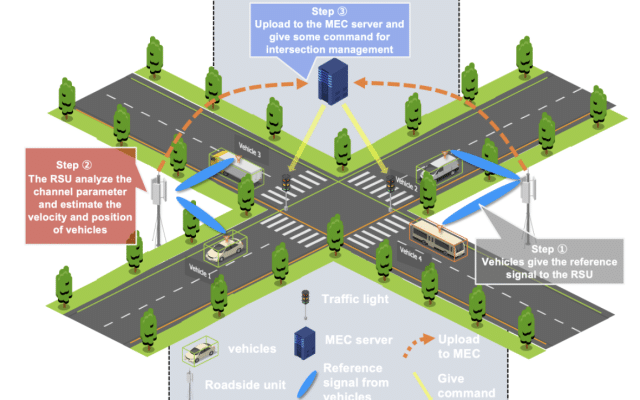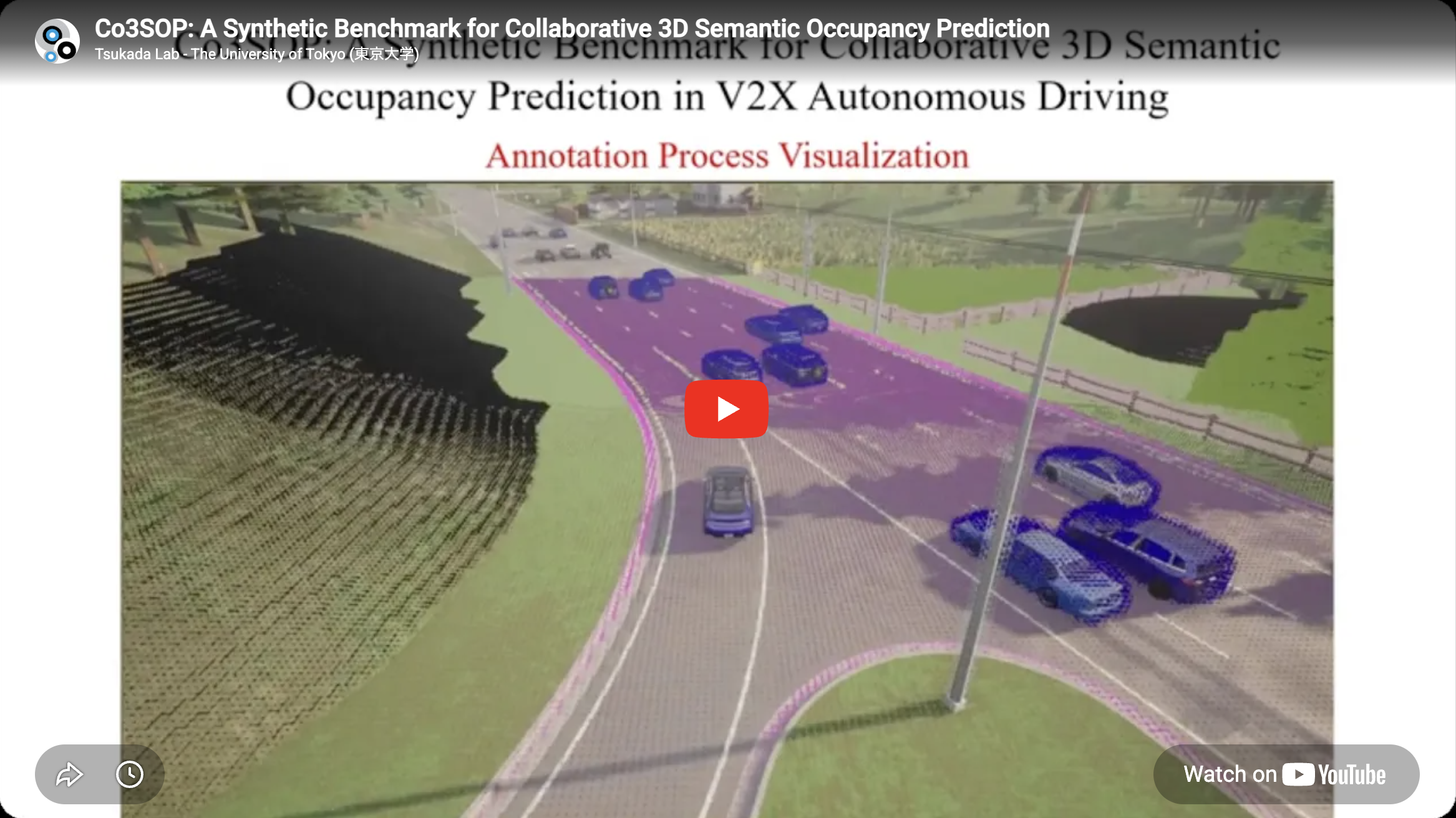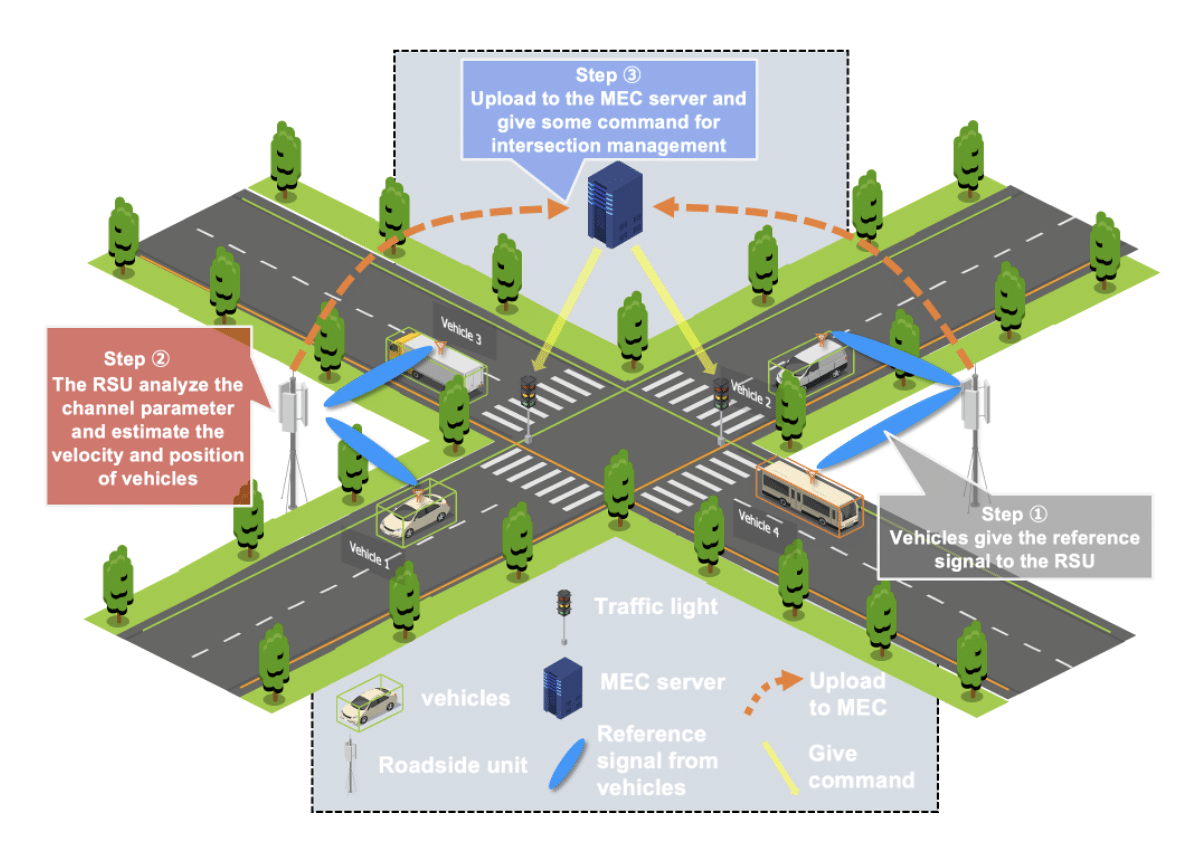
This project aims to enhance the Autoware autonomous driving software by integrating cooperative driving capabilities using vehicle-to-everything (V2X) communication. Instead of relying solely on onboard perception, our extensions allow autonomous vehicles to interact with each other and with roadside infrastructure, making driving behavior safer and more efficient in complex traffic scenarios.
The first major milestone was the development of AutowareV2X, a communication module that enables the exchange of Collective Perception Messages (CPMs). This allows vehicles to share object-level sensor data, effectively extending their field of view by leveraging information from other connected vehicles and infrastructure. Real-world experiments using actual vehicles confirmed that the system achieved reliable data sharing with low end-to-end latency around 30 milliseconds.
To improve reliability under unstable wireless conditions, we implemented a dual-channel hybrid delivery mechanism for CPMs, along with a real-time monitoring system for communication quality. This enabled dynamic selection of the freshest CPM among different wireless links, ensuring consistent and trustworthy data delivery even under packet loss conditions.
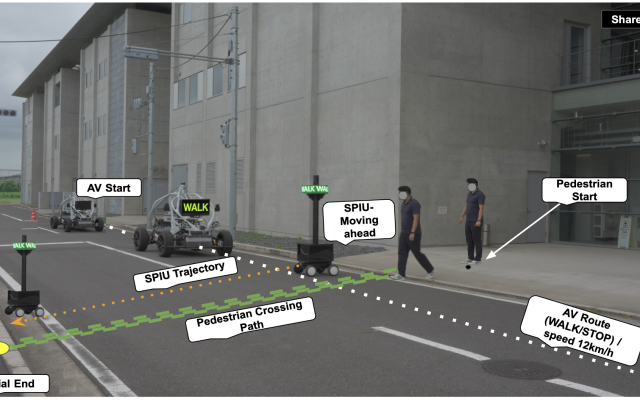
Beyond perception, we extended Autoware’s planning capabilities to support cooperative maneuver coordination. Vehicles can now share their future paths and dynamically adjust their behaviors based on potential conflicts or optimization opportunities, such as avoiding collisions or reducing travel time at intersections. Using the AutoMCM protocol, which defines seven abstracted coordination messages, we achieved efficient, event-driven communication with reduced bandwidth and strong robustness. Experiments showed that our system could reduce travel time by up to 28% compared to standalone driving, laying the groundwork for deployable cooperative driving systems.
@article{Asabe2024,
title = {Enhancing Reliability in Infrastructure-based Collective Perception: A Dual-Channel Hybrid Delivery Approach with Real-Time Monitoring},
author = {Yu Asabe and Ehsan Javanmardi and Jin Nakazato and Manabu Tsukada and Hiroshi Esaki},
doi = {10.1109/OJVT.2024.3443877},
issn = {2644-1330},
year = {2024},
date = {2024-08-30},
urldate = {2024-08-30},
journal = {IEEE Open Journal of Vehicular Technology},
volume = {5},
pages = {1124-1138},
abstract = {Standalone autonomous vehicles primarily rely on their onboard sensors and may have blind spots or limited situational awareness in complex or dynamic traffic scenarios, leading to difficulties in making safe decisions. Collective perception enables connected autonomous vehicles (CAVs) to overcome the limitations of standalone autonomous vehicles by sharing sensory information with nearby road users. However, unfavorable conditions of the wireless communication medium it uses can lead to limited reliability and reduced quality of service. In this paper, we propose methods for increasing the reliability of collective perception through real-time packet delivery rate monitoring and a dual-channel hybrid delivery approach. We have implemented AutowareV2X, a vehicle-to-everything (V2X) communication module integrated into the autonomous driving (AD) software Autoware. AutowareV2X provides connectivity to the AD stack, enabling end-to-end (E2E) experimentation and evaluation of CAVs. The Collective Perception Service (CPS) was also implemented, allowing the transmission of Collective Perception Messages (CPMs). Our proposed methods using AutowareV2X were evaluated using actual hardware and vehicles in reallife field tests. Results have indicated that the E2E network latency of the perception information sent is around 30 ms, and the AD software can use shared object data to conduct collision avoidance maneuvers. The dual-channel delivery of CPMs enabled the CAV to dynamically select the best CPM from CPMs received from different links, depending on the freshness of their information. This enabled the reliable transmission of CPMs even when there was significant packet loss on one of the transmitting channels.},
keywords = {},
pubstate = {published},
tppubtype = {article}
}
@inproceedings{Asabe2023b,
title = {AutowareV2X: Reliable V2X Communication and Collective Perception for Autonomous Driving},
author = {Yu Asabe and Ehsan Javanmardi and Jin Nakazato and Manabu Tsukada and Hiroshi Esaki},
url = {https://github.com/tlab-wide/AutowareV2X
https://tlab-wide.github.io/AutowareV2X/main/
https://www.youtube.com/watch?v=57fx3-gUNxU},
doi = {10.1109/VTC2023-Spring57618.2023.10199425},
year = {2023},
date = {2023-06-20},
urldate = {2023-06-20},
booktitle = {The 2023 IEEE 97th Vehicular Technology Conference (VTC2023-Spring)},
address = {Florence, Italy},
abstract = {For cooperative intelligent transport systems (C-ITS), vehicle-to-everything (V2X) communication is utilized to allow autonomous vehicles to share critical information with each other. We propose AutowareV2X, an implementation of a V2X communication module that is integrated into the autonomous driving (AD) software, Autoware. AutowareV2X provides external connectivity to the entire AD stack, enabling the end-to-end (E2E) experimentation and evaluation of connected autonomous vehicles (CAV). The Collective Perception Service was also implemented, allowing the transmission of Collective Perception Messages (CPMs). A dual-channel mechanism that enables wireless link redundancy on the critical object information shared by CPMs is also proposed. Performance evaluation in field experiments has indicated that the E2E latency of perception information is around 30 ms, and shared object data can be used by the AD software to conduct collision avoidance maneuvers. Dual-channel delivery of CPMs enabled the CAV to dynamically select the best CPM from CPMs received from different links, depending on the freshness of their information.},
keywords = {},
pubstate = {published},
tppubtype = {inproceedings}
}
@inproceedings{Hirata2021b,
title = {Roadside-assisted Cooperative Planning using Future Path Sharing for Autonomous Driving},
author = {Mai Hirata and Manabu Tsukada and Keisuke Okumura and Yasumasa Tamura and Hideya Ochiai and Xavier Défago},
url = {https://arxiv.org/abs/2108.04629
https://youtu.be/xaBIQC0SClE},
doi = {10.1109/VTC2021-Fall52928.2021.9625324},
year = {2021},
date = {2021-09-27},
urldate = {2021-09-27},
booktitle = {IEEE 94th Vehicular Technology Conference (VTC2021-Fall)},
address = {Online},
abstract = {Cooperative intelligent transportation systems (ITS) are used by autonomous vehicles to communicate with surrounding autonomous vehicles and roadside units (RSU). Current C-ITS applications focus primarily on real-time information sharing, such as cooperative perception. In addition to real-time information sharing, self-driving cars need to coordinate their action plans to achieve higher safety and efficiency. For this reason, this study defines a vehicle’s future action plan/path and designs a cooperative path-planning model at intersections using future path sharing based on the future path information of multiple vehicles. The notion is that when the RSU detects a potential conflict of vehicle paths or an acceleration opportunity according to the shared future paths, it will generate a coordinated path update that adjusts the speeds of the vehicles. We implemented the proposed method using the open-source Autoware autonomous driving software and evaluated it with the LGSVL autonomous vehicle simulator. We conducted simulation experiments with two vehicles at a blind intersection scenario, finding that each car can travel safely and more efficiently by planning a path that reflects the action plans of all vehicles involved. The time consumed by introducing the RSU is 23.0 % and 28.1 % shorter than that of the stand-alone autonomous driving case at the intersection.},
keywords = {},
pubstate = {published},
tppubtype = {inproceedings}
}
@inproceedings{Mizutani2021b,
title = {AutoMCM: Maneuver Coordination Service with Abstracted Functions for Autonomous Driving},
author = {Masaya Mizutani and Manabu Tsukada and Hiroshi Esaki},
url = {https://arxiv.org/abs/2107.06627
https://youtu.be/eC7L0R_1Ybo
https://youtu.be/s3l5zypizxQ
https://youtu.be/XBpZeT-apGE},
doi = {10.1109/ITSC48978.2021.9564556},
year = {2021},
date = {2021-09-19},
urldate = {2021-09-19},
booktitle = {24th IEEE International Conference on Intelligent Transportation (ITSC)},
address = {Indianapolis, IN, United States},
abstract = {A cooperative intelligent transport system (C-ITS) uses vehicle-to-everything (V2X) technology to make self-driving vehicles safer and more efficient. Current C-ITS applications have mainly focused on real-time information sharing, such as for cooperative perception. In addition to better real-time perception, self-driving vehicles need to achieve higher safety and efficiency by coordinating action plans. This study designs a maneuver coordination (MC) protocol that uses seven messages to cover various scenarios and an abstracted MC support service. We implement our proposal as AutoMCM by extending two open-source software tools: Autoware for autonomous driving and OpenC2X for C-ITS. The results show that our system effectively reduces the communication bandwidth by limiting message exchange in an event-driven manner. Furthermore, it shows that the vehicles run 15% faster when the vehicle speed is 30 km/h and 28% faster when the vehicle speed is 50 km/h using our scheme. Our system shows robustness against packet loss in experiments when the message timeout parameters are appropriately set.},
keywords = {},
pubstate = {published},
tppubtype = {inproceedings}
}
digital twins extended reality
digital twins
autonomous driving machine learning
machine learning v2x
autonomous driving v2x
extended reality
v2x
machine learning v2x
We are part of the University of Tokyo’s Graduate School of Information Science and Technology, Department of Creative Informatics and focuses on computer networks and cyber-physical systems
Address
4F, I-REF building, Graduate School of Information Science and Technology, The University of Tokyo, 1-1-1, Yayoi, Bunkyo-ku, Tokyo, 113-8657 Japan
Room 91B1, Bld 2 of Engineering Department, The University of Tokyo, 7-3-1 Hongo, Bunkyo-ku, Tokyo 113-8656, Japan
Mail: