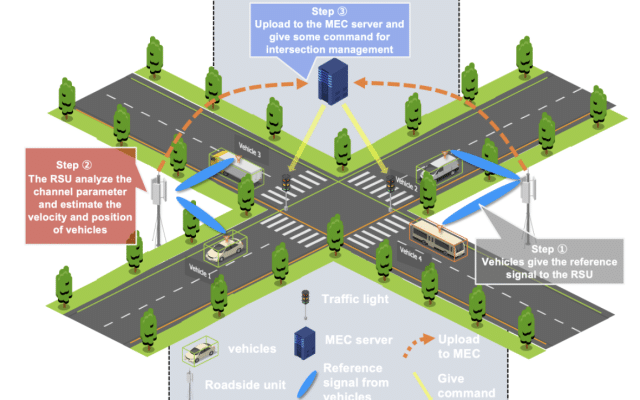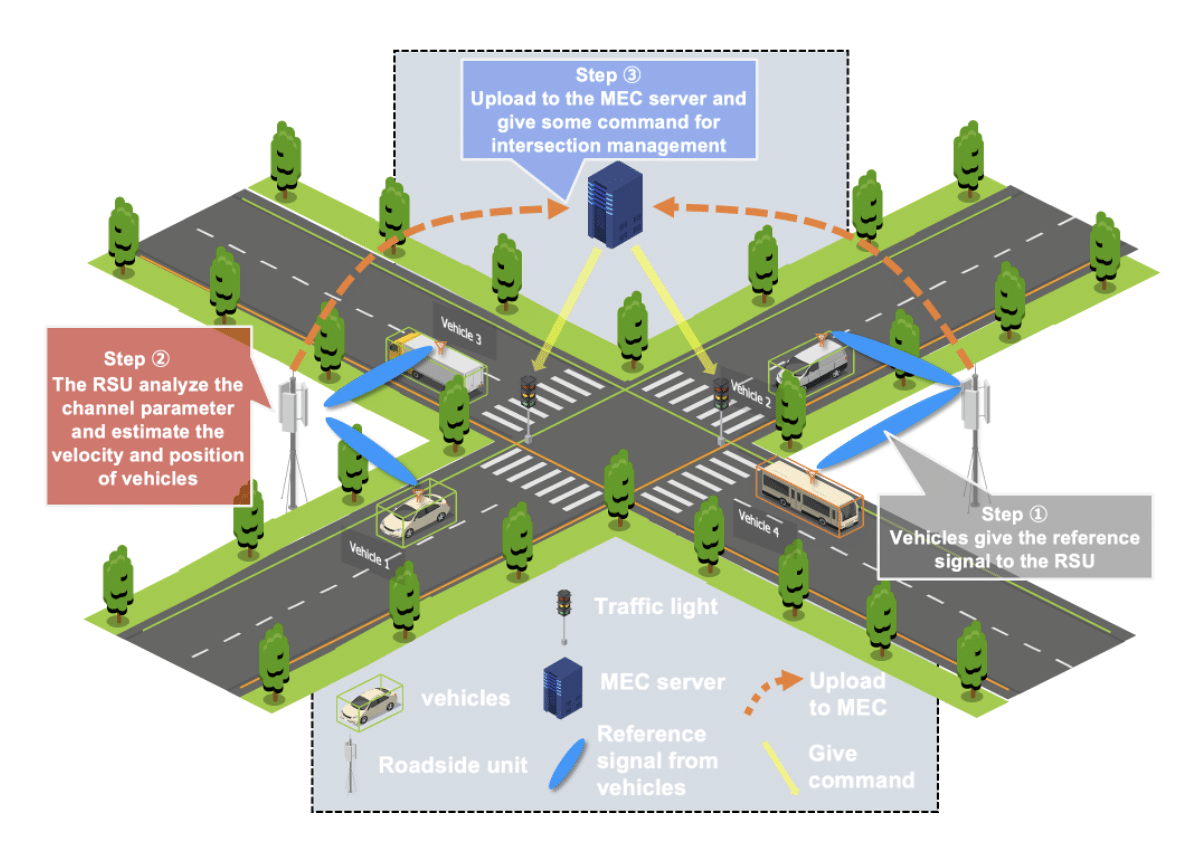
自動運転技術の発展に伴い、車両だけでなくインフラ側にも知覚能力と通信能力を持たせる「協調認識(Cooperative Perception)」の重要性が高まっています。特に、死角に存在する歩行者や非コネクテッド車両の検出、混合交通環境への対応など、インフラによる支援は交通安全の要となります。本研究では、センサと通信機能を統合した路側知覚ユニット(Roadside Perception Unit: RSPU)を開発し、インフラベースの協調認識を実現するためのシステム設計と評価を行ってきました。
RSPUは、LiDARやカメラ、レーダーなどを搭載し、周囲の交通状況をリアルタイムで把握しながら、車両に対して協調認識メッセージを生成・配信する機能を持ちます。さらに、複数のRSPUを有線ネットワークで接続する「ネットワーク型RSPU」構成を提案し、道路全体を一つのセンサネットワークとして機能させることで、広域かつ高精度な認識が可能になります。これにより、個々の車両では不可能な情報の取得と伝達が実現します。
提案したRSPUシステムは、フィールド実験・数値解析・ネットワークシミュレーションにより性能評価されました。特に、提案した優先度制御アルゴリズムを用いることで、通信混雑時にも遅延を抑えつつ、重要度の高い情報を優先的に配信することが可能であることが確認されました。また、実車試験においても、協調認識メッセージを最悪条件でも100ミリ秒以内で車両に届けることに成功しています。
これらの研究成果は、「AutoC2X」としてオープンソースで公開されており、開発者・研究者による試作や実装、都市部への応用展開を後押ししています。今後は、エッジコンピューティングとの連携や、次世代ITS(Intelligent Transport Systems)との統合により、RSPUを中心としたインフラ主導の高度協調型交通インフラの実現を目指します。
@inproceedings{Tsukada2020,
title = {AutoC2X: Open-source software to realize V2X cooperative perception among autonomous vehicles},
author = {Manabu Tsukada and Takaharu Oi and Akihide Ito and Mai Hirata and Hiroshi Esaki},
url = {https://github.com/esakilab/AutoC2X-AW
https://hal.archives-ouvertes.fr/hal-02942051/document?.pdf
https://youtu.be/kyv0sTyCIgU},
doi = {10.1109/VTC2020-Fall49728.2020.9348525},
year = {2020},
date = {2020-11-18},
urldate = {2020-11-18},
booktitle = {The 2020 IEEE 92nd Vehicular Technology Conference (VTC2020-Fall)},
address = {Victoria, B.C., Canada},
abstract = {The realization of vehicle-to-everything (V2X) communication enhances the capabilities of autonomous vehicles in terms of safety efficiency and comfort. In particular, sensor data sharing, known as cooperative perception, is a crucial technique to accommodate vulnerable road users in a cooperative intelligent transport system (ITS). In this regard, open-source software plays a significant role in prototyping, validation, and deployment. Specifically, in the developer community, Autoware is a popular open-source software for self-driving vehicles, and OpenC2X is an open-source experimental and prototyping platform for cooperative ITS. This paper reports on a system named AutoC2X to enable cooperative perception by using OpenC2X for Autoware-based autonomous vehicles. The developed system is evaluated by conducting field experiments involving real hardware. The results demonstrate that AutoC2X can deliver the cooperative perception message within 100 ms in the worst case. },
keywords = {},
pubstate = {published},
tppubtype = {inproceedings}
}
@article{Tsukada2020b,
title = {Networked Roadside Perception Units for Autonomous Driving},
author = {Manabu Tsukada and Takaharu Oi and Masahiro Kitazawa and Hiroshi Esaki
},
url = {https://www.mdpi.com/1424-8220/20/18/5320/pdf?.pdf
https://youtu.be/n7gD0L7NDEM},
doi = {10.3390/s20185320},
issn = {1424-8220},
year = {2020},
date = {2020-09-17},
urldate = {2020-09-17},
journal = {MDPI Sensors},
volume = {20},
number = {18},
abstract = {Vehicle-to-Everything (V2X) communication enhances the capability of autonomous driving through better safety, efficiency, and comfort. In particular, sensor data sharing, known as cooperative perception, is a crucial technique to accommodate vulnerable road users in a cooperative intelligent transport system (ITS). In this paper, we describe a roadside perception unit (RSPU) that combines sensors and roadside units (RSUs) for infrastructure-based cooperative perception. We propose a software called AutoC2X that we designed to realize cooperative perception for RSPUs and vehicles. We also propose the concept of networked RSPUs, which is the inter-connection of RSPUs along a road over a wired network, and helps realize broader cooperative perception. We evaluated the RSPU system and the networked RSPUs through a field test, numerical analysis, and simulation experiments. Field evaluation showed that, even in the worst case, our RSPU system can deliver messages to an autonomous vehicle within 100 ms. The simulation result shows that the proposed priority algorithm achieves a wide perception range with a high delivery ratio and low latency, especially under heavy road traffic conditions. },
keywords = {},
pubstate = {published},
tppubtype = {article}
}
@inproceedings{Tsukada2019b,
title = {Cooperative awareness using roadside unit networks in mixed traffic},
author = {Manabu Tsukada and Masahiro Kitazawa and Takaharu Oi and Hideya Ochiai and Hiroshi Esaki
},
url = {https://hal.archives-ouvertes.fr/hal-02335068/?.pdf},
doi = {10.1109/VNC48660.2019.9062773},
year = {2019},
date = {2019-12-04},
booktitle = {2019 IEEE Vehicular Networking Conference (VNC)},
pages = {9-16},
abstract = {Vehicle-to-vehicle (V2V) messaging is an indispensable component of connected autonomous vehicle systems. Although V2V standards have been specified by the European Union, United States, and Japan, the deployment phase represents mixed traffic in which connected and legacy vehicles co-exist. To enhance cooperative awareness in this mixed traffic, we assessed the special roadside unit that we developed in our previous work that generates required V2V messages on behalf of sensed target vehicles. In this paper, we extend our earlier work to propose a system called “Grid Proxy Cooperative Awareness Message to broaden the cooperative awareness message dissemination area by connecting infrastructure using high-speed roadside networks. To minimize delay in message delivery, we designed the proposed system to use edge computing. The proposed scheme delivers cooperative messages to a wider area with a low delay and a high packet delivery ratio by prioritizing packets by their respective safety contributions. Our simulation results indicate that the proposed scheme efficiently delivers messages in heavy road traffic conditions modeled on real maps of Tokyo and Paris. },
keywords = {},
pubstate = {published},
tppubtype = {inproceedings}
}
digital twins extended reality
digital twins
autonomous driving machine learning
machine learning v2x
autonomous driving v2x
extended reality
machine learning v2x