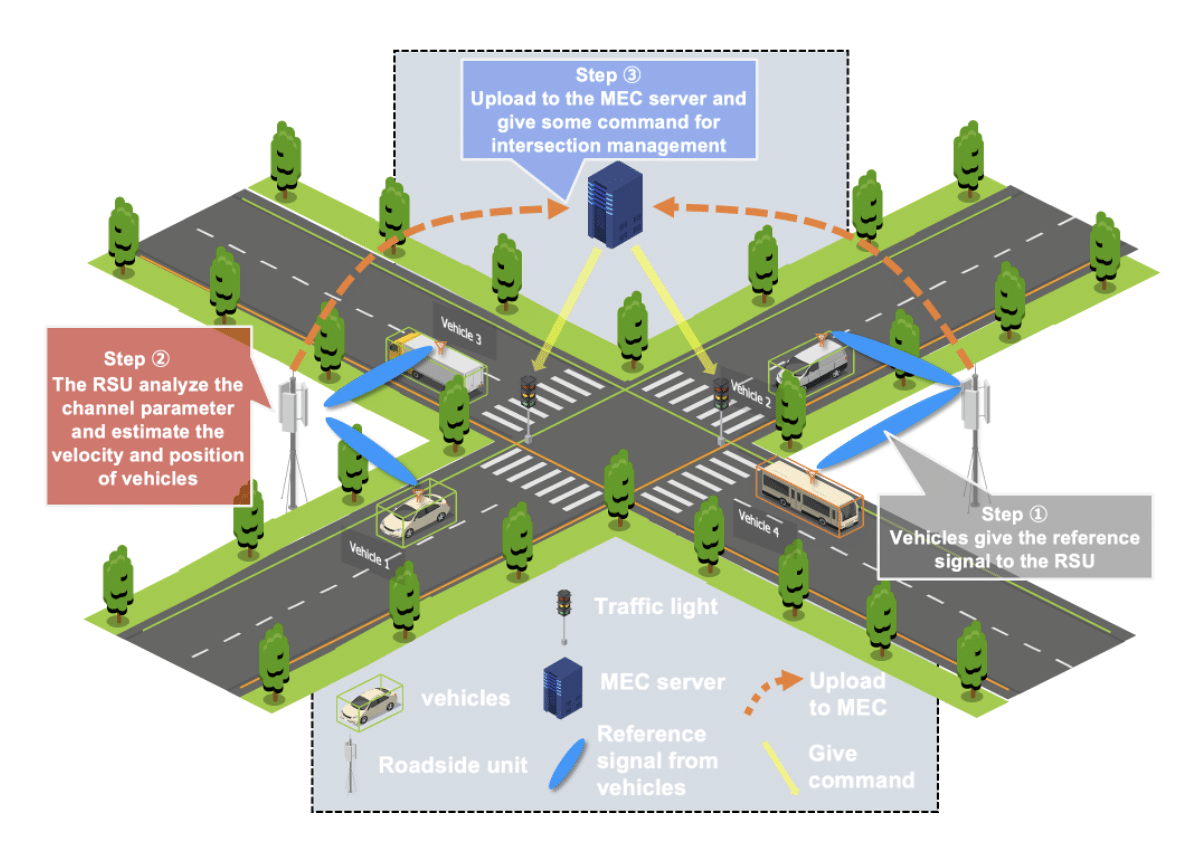
As autonomous driving technologies evolve, the importance of infrastructure-based sensing and communication is growing rapidly. Cooperative perception, which allows sharing of sensor data among vehicles and infrastructure, is especially crucial for detecting vulnerable road users and handling mixed traffic environments. In this project, we developed Roadside Perception Units (RSPUs), which combine sensing and communication capabilities to support autonomous vehicles from the roadside. Our goal is to enable a robust and scalable infrastructure-led cooperative perception system.
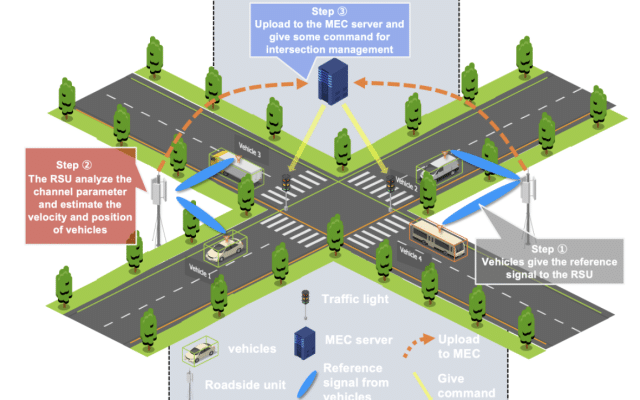
Each RSPU is equipped with sensors such as LiDAR, cameras, and radar, and is capable of analyzing the surrounding traffic environment in real time. These units generate and transmit cooperative perception messages to nearby vehicles. To extend coverage, we introduced the concept of “networked RSPUs,” where multiple RSPUs are connected via wired infrastructure networks. This architecture transforms the road itself into a distributed sensor network, enabling large-scale environmental awareness that goes beyond the capability of individual vehicles.
We evaluated the proposed RSPU system through field experiments, simulations, and numerical analysis. A key contribution is our priority-based communication algorithm, which ensures low latency and high delivery rates, even under heavy traffic conditions. Field tests showed that the system can reliably transmit cooperative perception messages to vehicles within 100 milliseconds, meeting real-time requirements for safety-critical applications.
The RSPU platform and supporting software, collectively named “AutoC2X,” have been released as open-source, accelerating community-based development and real-world deployment. Looking ahead, we aim to integrate edge computing and expand to smart city-scale ITS infrastructure, where RSPUs act as a foundation for future-ready, cooperative, and intelligent transport networks.
@inproceedings{Tsukada2020,
title = {AutoC2X: Open-source software to realize V2X cooperative perception among autonomous vehicles},
author = {Manabu Tsukada and Takaharu Oi and Akihide Ito and Mai Hirata and Hiroshi Esaki},
url = {https://github.com/esakilab/AutoC2X-AW
https://hal.archives-ouvertes.fr/hal-02942051/document?.pdf
https://youtu.be/kyv0sTyCIgU},
doi = {10.1109/VTC2020-Fall49728.2020.9348525},
year = {2020},
date = {2020-11-18},
urldate = {2020-11-18},
booktitle = {The 2020 IEEE 92nd Vehicular Technology Conference (VTC2020-Fall)},
address = {Victoria, B.C., Canada},
abstract = {The realization of vehicle-to-everything (V2X) communication enhances the capabilities of autonomous vehicles in terms of safety efficiency and comfort. In particular, sensor data sharing, known as cooperative perception, is a crucial technique to accommodate vulnerable road users in a cooperative intelligent transport system (ITS). In this regard, open-source software plays a significant role in prototyping, validation, and deployment. Specifically, in the developer community, Autoware is a popular open-source software for self-driving vehicles, and OpenC2X is an open-source experimental and prototyping platform for cooperative ITS. This paper reports on a system named AutoC2X to enable cooperative perception by using OpenC2X for Autoware-based autonomous vehicles. The developed system is evaluated by conducting field experiments involving real hardware. The results demonstrate that AutoC2X can deliver the cooperative perception message within 100 ms in the worst case. },
keywords = {},
pubstate = {published},
tppubtype = {inproceedings}
}
@article{Tsukada2020b,
title = {Networked Roadside Perception Units for Autonomous Driving},
author = {Manabu Tsukada and Takaharu Oi and Masahiro Kitazawa and Hiroshi Esaki
},
url = {https://www.mdpi.com/1424-8220/20/18/5320/pdf?.pdf
https://youtu.be/n7gD0L7NDEM},
doi = {10.3390/s20185320},
issn = {1424-8220},
year = {2020},
date = {2020-09-17},
urldate = {2020-09-17},
journal = {MDPI Sensors},
volume = {20},
number = {18},
abstract = {Vehicle-to-Everything (V2X) communication enhances the capability of autonomous driving through better safety, efficiency, and comfort. In particular, sensor data sharing, known as cooperative perception, is a crucial technique to accommodate vulnerable road users in a cooperative intelligent transport system (ITS). In this paper, we describe a roadside perception unit (RSPU) that combines sensors and roadside units (RSUs) for infrastructure-based cooperative perception. We propose a software called AutoC2X that we designed to realize cooperative perception for RSPUs and vehicles. We also propose the concept of networked RSPUs, which is the inter-connection of RSPUs along a road over a wired network, and helps realize broader cooperative perception. We evaluated the RSPU system and the networked RSPUs through a field test, numerical analysis, and simulation experiments. Field evaluation showed that, even in the worst case, our RSPU system can deliver messages to an autonomous vehicle within 100 ms. The simulation result shows that the proposed priority algorithm achieves a wide perception range with a high delivery ratio and low latency, especially under heavy road traffic conditions. },
keywords = {},
pubstate = {published},
tppubtype = {article}
}
@inproceedings{Tsukada2019b,
title = {Cooperative awareness using roadside unit networks in mixed traffic},
author = {Manabu Tsukada and Masahiro Kitazawa and Takaharu Oi and Hideya Ochiai and Hiroshi Esaki
},
url = {https://hal.archives-ouvertes.fr/hal-02335068/?.pdf},
doi = {10.1109/VNC48660.2019.9062773},
year = {2019},
date = {2019-12-04},
booktitle = {2019 IEEE Vehicular Networking Conference (VNC)},
pages = {9-16},
abstract = {Vehicle-to-vehicle (V2V) messaging is an indispensable component of connected autonomous vehicle systems. Although V2V standards have been specified by the European Union, United States, and Japan, the deployment phase represents mixed traffic in which connected and legacy vehicles co-exist. To enhance cooperative awareness in this mixed traffic, we assessed the special roadside unit that we developed in our previous work that generates required V2V messages on behalf of sensed target vehicles. In this paper, we extend our earlier work to propose a system called “Grid Proxy Cooperative Awareness Message to broaden the cooperative awareness message dissemination area by connecting infrastructure using high-speed roadside networks. To minimize delay in message delivery, we designed the proposed system to use edge computing. The proposed scheme delivers cooperative messages to a wider area with a low delay and a high packet delivery ratio by prioritizing packets by their respective safety contributions. Our simulation results indicate that the proposed scheme efficiently delivers messages in heavy road traffic conditions modeled on real maps of Tokyo and Paris. },
keywords = {},
pubstate = {published},
tppubtype = {inproceedings}
}
digital twins extended reality
digital twins
autonomous driving machine learning
machine learning v2x
autonomous driving v2x
extended reality
v2x
machine learning v2x
We are part of the University of Tokyo’s Graduate School of Information Science and Technology, Department of Creative Informatics and focuses on computer networks and cyber-physical systems
Address
4F, I-REF building, Graduate School of Information Science and Technology, The University of Tokyo, 1-1-1, Yayoi, Bunkyo-ku, Tokyo, 113-8657 Japan
Room 91B1, Bld 2 of Engineering Department, The University of Tokyo, 7-3-1 Hongo, Bunkyo-ku, Tokyo 113-8656, Japan
Mail: