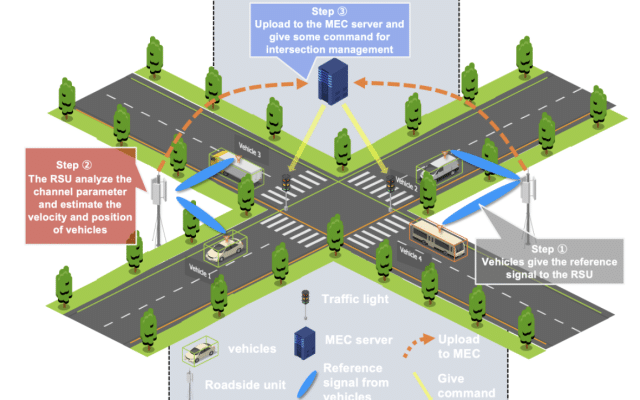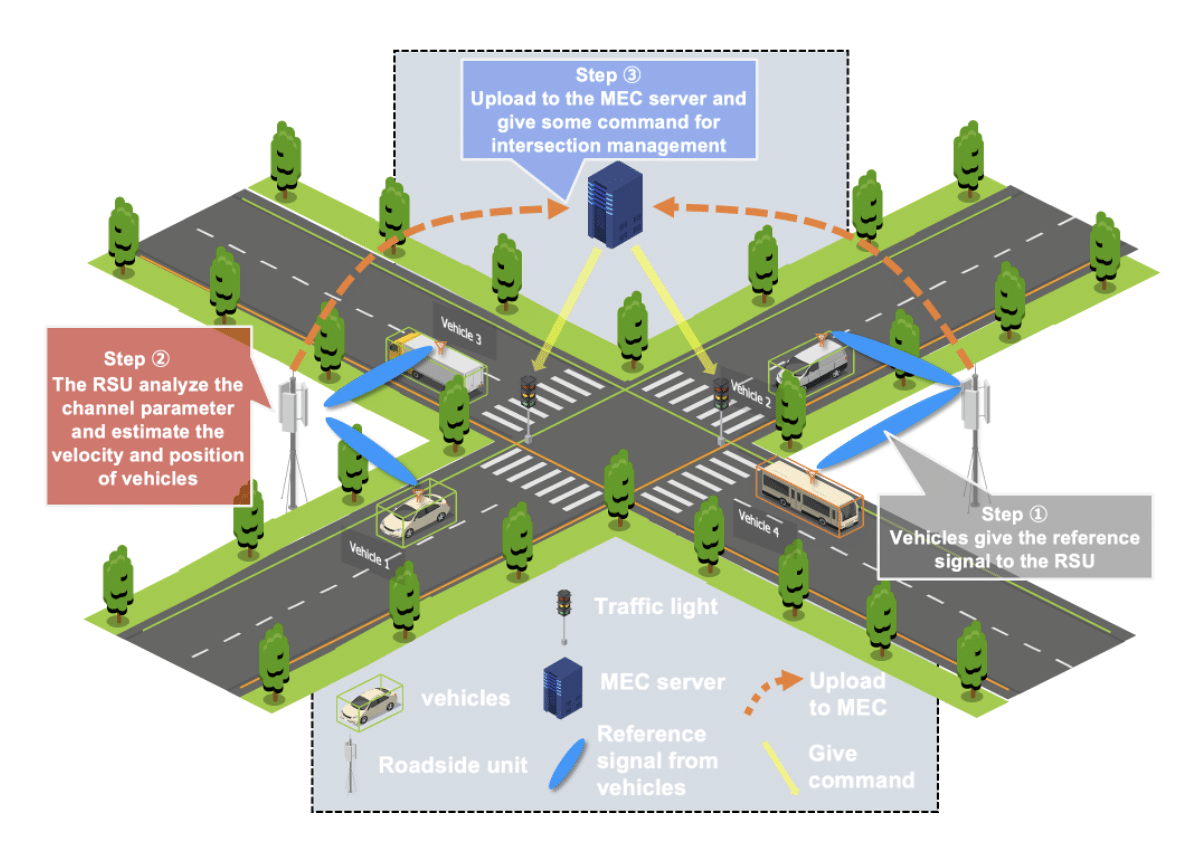
As connected autonomous vehicles (CAVs) become more prevalent, the need for adaptive, secure, and efficient learning systems grows. Traditional centralized AI training approaches face limitations in coping with diverse environments and privacy concerns. To address this, our research explores the use of Federated Learning (FL), in combination with Multi-access Edge Computing (MEC), as a decentralized AI platform for autonomous vehicles and vehicular networks.
One of our key studies proposes an MEC-assisted FL framework where edge nodes act as aggregators and cache environment-specific models. These dedicated models are updated and distributed to individual vehicles, resulting in improved performance over general-purpose models. Simulation results show that the proposed system consistently outperforms baseline approaches, especially under varying road and weather conditions. Furthermore, novel scheduling algorithms enable effective utilization of edge computing resources while reducing communication costs.
To enhance trust and security, we introduced a Blockchain-integrated Federated Learning framework called SEBFL. This system leverages homomorphic encryption to maintain privacy during the exchange of learning parameters between vehicles, infrastructure, and cloud servers. Our evaluations demonstrated the system’s resilience to privacy attacks such as model inversion and membership inference, while maintaining high inference accuracy.
In addition, we investigated the application of FL in Open RAN environments for vehicular communications. This work proposes a unified framework that tackles communication efficiency, adaptive learning, and data privacy in a single system. As part of our ongoing research, we continue to explore distributed AI platforms that empower cooperative and intelligent transport systems, advancing the future of safe and scalable autonomous mobility.
@article{Asad2024b,
title = {Federated Learning for Secure and Efficient Vehicular Communications in Open RAN},
author = {Muhammad Asad and Saima Shaukat and Jin Nakazato and Ehsan Javanmardi and Manabu Tsukada},
url = {https://rdcu.be/d7RSW},
doi = {10.1007/s10586-024-04932-3},
issn = {1386-7857},
year = {2025},
date = {2025-01-28},
urldate = {2024-11-25},
journal = {Cluster Computing},
volume = {28},
number = {211},
abstract = {This paper presents a comprehensive exploration of federated learning applied to vehicular communications within the context of Open RAN. Through an in-depth review of existing literature and analysis of fundamental concepts, critical challenges are identified within the current methodologies employed in this sphere. A novel framework is proposed to address these shortcomings, fundamentally based on federated learning principles. This framework aims to enhance security and efficiency in vehicular communications, leveraging the flexibility of Open RAN architecture. The paper further delves into a rigorous justification of the proposed solution, highlighting its potential impact and the improvements it could bring to vehicular communications. Ultimately, this study provides a roadmap for future research in applying federated learning for more secure and efficient vehicular communications in Open RAN, opening up new avenues for exploration in this exciting interdisciplinary domain.},
keywords = {},
pubstate = {published},
tppubtype = {article}
}
@article{Asad2024,
title = {Secure and Efficient Blockchain-based Federated Learning Approach For VANETs},
author = {Muhammad Asad and Saima Shaukat and Ehsan Javanmardi and Jin Nakazato and Naren Bao and Manabu Tsukada},
doi = {10.1109/JIOT.2023.3322221},
issn = {2327-4662},
year = {2024},
date = {2024-03-01},
urldate = {2023-10-05},
journal = {IEEE Internet of Things Journal},
volume = {11},
issue = {5},
pages = {9047-9055},
abstract = {The rapid increase in the number of connected vehicles on roads has made Vehicular Ad-hoc Networks (VANETs) an attractive target for malicious actors. As a result, VANETs require secure data transmission to maintain the network’s integrity. Federated Learning (FL) has been proposed as a secure data-sharing method for VANETs, but it is limited in its ability to protect sensitive data. This paper proposes integrating Blockchain technology into FL to provide an additional layer of security for VANETs. In particular, we propose a Secure and Efficient Blockchain-based FL (SEBFL) approach to ensure communication efficiency and data privacy in VANETs. To this end, we use the FL model for VANETs, where computation tasks are decomposed from a base station to individual vehicles. This effectively reduces the congestion delay and communication overhead. Integrating blockchain with the FL model provides a reliable and secure data communication system between vehicles, roadside units, and a cloud server. Additionally, we use a Homomorphic Encryption System (HES) that effectively preserves the confidentiality and credibility of vehicles. Besides, the proposed SEBFL leverages the asynchronous FL model, minimizing the long delay while avoiding possible threats and attacks using HES. The experiment results show the proposed SEBFL achieves 0.87% accuracy while a model inversion attack and 0.86% accuracy while a membership inference attack.},
keywords = {},
pubstate = {published},
tppubtype = {article}
}
@article{Asad2023b,
title = {Limitations and Future Aspects of Communication Costs in Federated Learning: A Survey},
author = {Muhammad Asad and Saima Shaukat and Dou Hu and Zekun Wang and Ehsan Javanmardi and Jin Nakazato and Manabu Tsukada},
doi = {10.3390/s23177358},
issn = {1424-8220},
year = {2023},
date = {2023-08-23},
urldate = {2023-08-23},
journal = {Sensors},
volume = {23},
number = {17},
abstract = {This paper explores the potential for communication-efficient federated learning (FL) in modern distributed systems. FL is an emerging distributed machine learning technique that allows for distributed training of a single machine learning model across multiple geographically distributed clients. This paper surveys the various approaches to communication-efficient FL, including model updates, compression techniques, resource management for edge and cloud, and client selection. We also review the various optimization techniques associated with communication-efficient FL, such as compression schemes and structured updates. Finally, we highlight the current research challenges and discuss the potential future directions for communication-efficient FL.},
keywords = {},
pubstate = {published},
tppubtype = {article}
}
@inproceedings{Wang2023,
title = {Overcoming Environmental Challenges in CAVs Through MEC-Based Federated Learning},
author = {Zekun Wang and Jin Nakazato and Muhammad Asad and Ehsan Javanmardi and Manabu Tsukada},
url = {https://www.researchgate.net/profile/Jin-Nakazato/publication/371685830_Overcoming_Environmental_Challenges_in_CAVs_through_MEC-based_Federated_Learning/links/64a420ea8de7ed28ba7465c7/Overcoming-Environmental-Challenges-in-CAVs-through-MEC-based-Federated-Learning.pdf},
doi = {10.1109/ICUFN57995.2023.10200688},
year = {2023},
date = {2023-07-04},
urldate = {2023-07-04},
booktitle = {14th International Conference on Ubiquitous and Future Networks (ICUFN2023)},
pages = {1-6},
address = {Paris, France},
abstract = {Connected autonomous vehicles (CAVs), through vehicle-to-everything communication and computing resources, enable the vital exchange of information. Although deep learning is crucial in this landscape, it requires extensive and intricate datasets covering all potential scenarios. Furthermore, this situation poses a hazard, as the likelihood of accidents associated with imbalanced datasets increases, particularly in scenarios where processing analysis is compromised due to fluctuating weather conditions. We propose a Federated Learning (FL) framework undergirded by Multi-Access Edge Computing (MEC) to counter these challenges. This local device-focused framework enhances task-specific models' caching and continual updating across various conditions. In a more specific sense, edge nodes (ENs) operate as MEC, each caching multiple dedicated models and serving as the aggregator as part of the FL process. Additionally, we have engineered two innovative algorithms that categorize various states into multiple classes, thereby ensuring the efficient utilization of computing resources in ENs. Simulation results substantiate the effectiveness of our approach, showing that the proposed dedicated model consistently outperforms a general model designed for all situations.},
keywords = {},
pubstate = {published},
tppubtype = {inproceedings}
}
autonomous driving v2x
v2x
digital twins extended reality
digital twins
autonomous driving machine learning
machine learning v2x
autonomous driving v2x
extended reality
We are part of the University of Tokyo’s Graduate School of Information Science and Technology, Department of Creative Informatics and focuses on computer networks and cyber-physical systems
Address
4F, I-REF building, Graduate School of Information Science and Technology, The University of Tokyo, 1-1-1, Yayoi, Bunkyo-ku, Tokyo, 113-8657 Japan
Room 91B1, Bld 2 of Engineering Department, The University of Tokyo, 7-3-1 Hongo, Bunkyo-ku, Tokyo 113-8656, Japan
Mail: