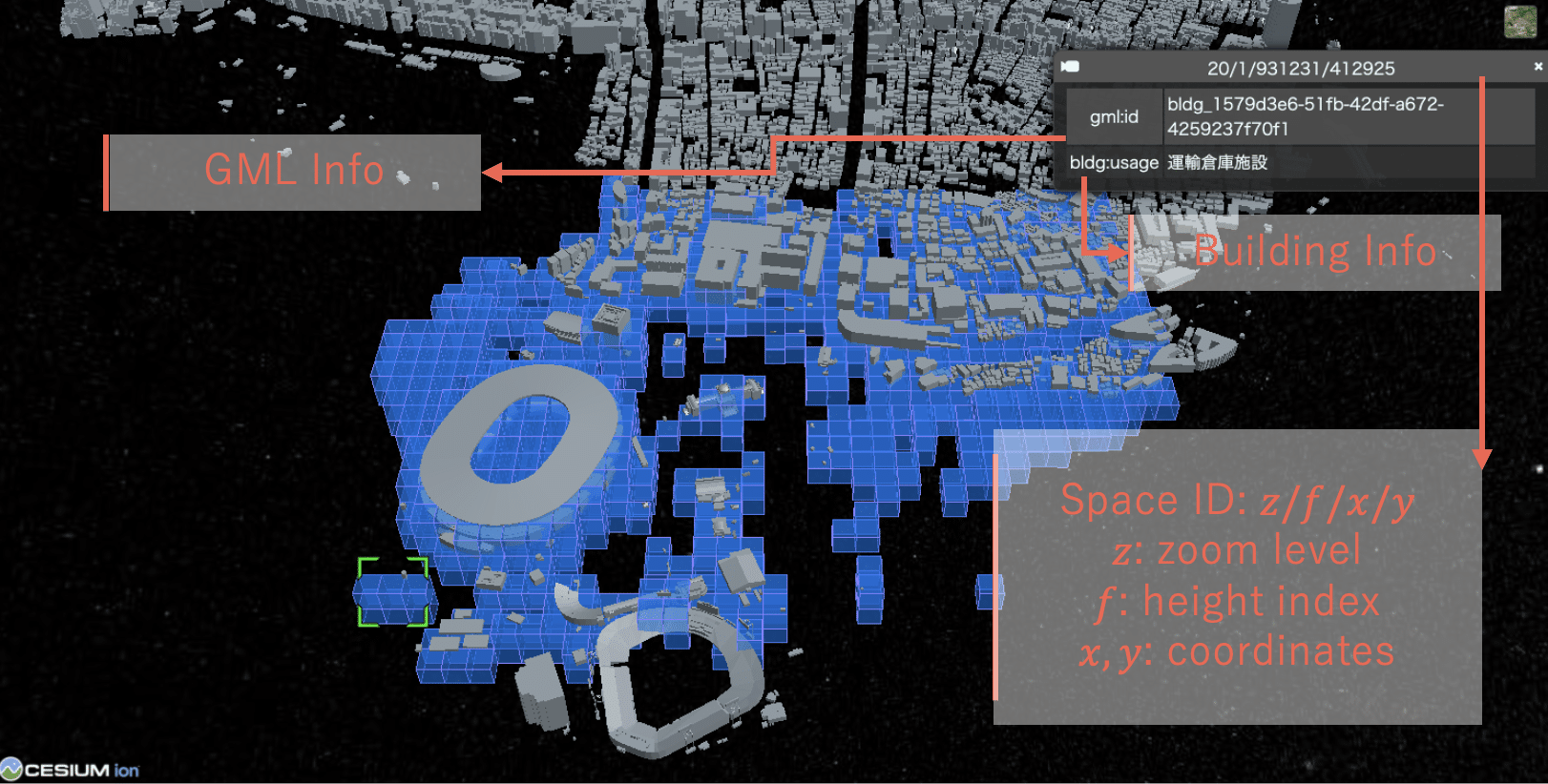
デジタルツイン技術は、建築物の設計・施工から運用・維持管理までのライフサイクル全体にわたって、物理空間の状態を仮想空間で再現・活用する手段として注目されています。塚田研究室では、BIM(Building Information Modeling)を基盤とした「BIMベースデジタルツイン」の設計と応用に取り組み、建築構造・空間音響・意味的情報を統合する新たな情報プラットフォームの構築を進めています。
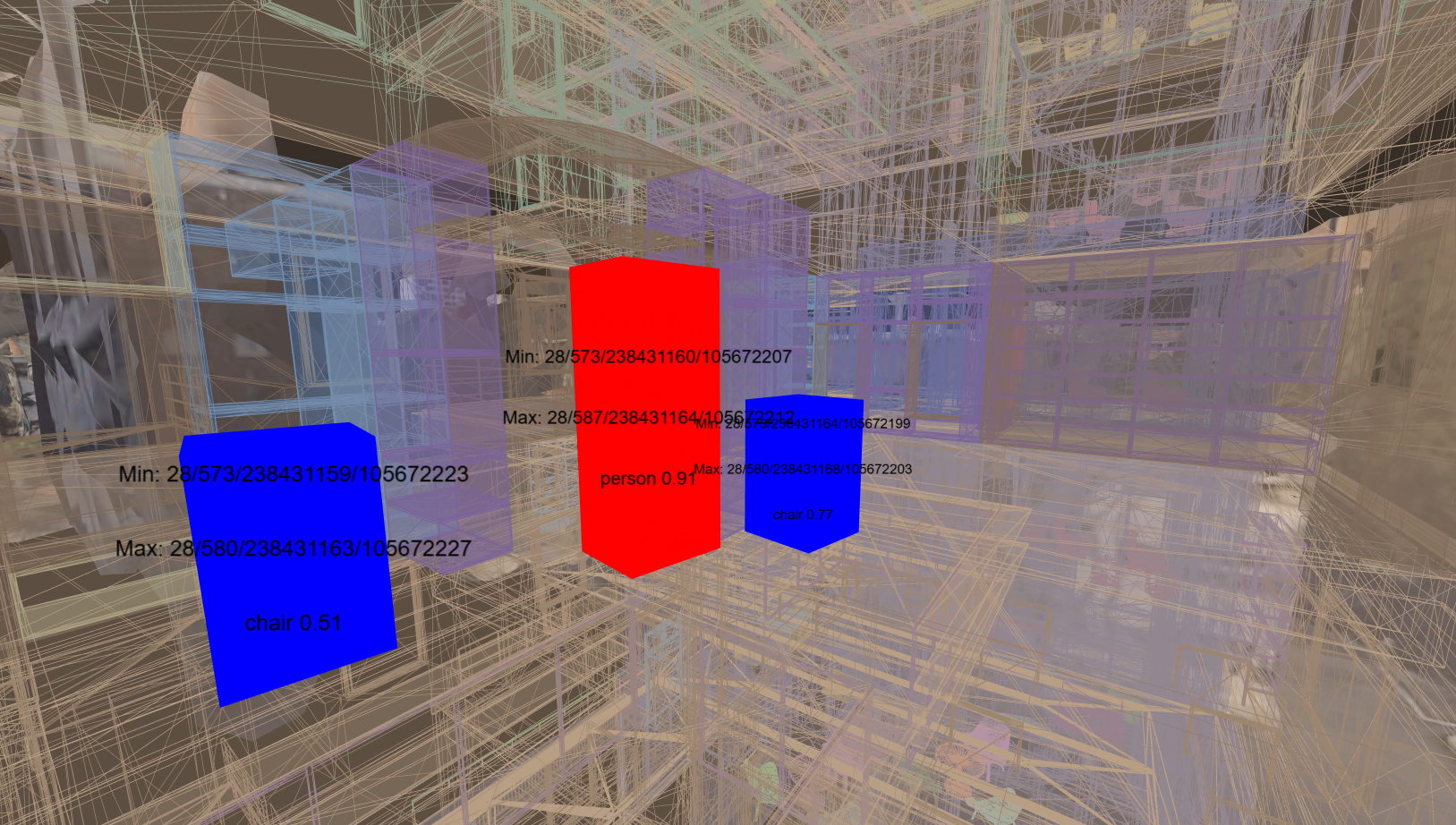
建築物におけるBIMベースデジタルツインの研究では、ジオメトリとセマンティクスの両方を持つBIMデータを、動的な屋内環境とリアルタイムで連携させるWebプラットフォームを開発しました。従来の静的なBIMの課題を克服するため、センサーデータと連動した状態の更新、インターフェースの視覚化、直感的な操作性に重点を置いて設計されました。ユーザ評価では、運用フェーズにおける利便性や拡張性が高く評価されています。
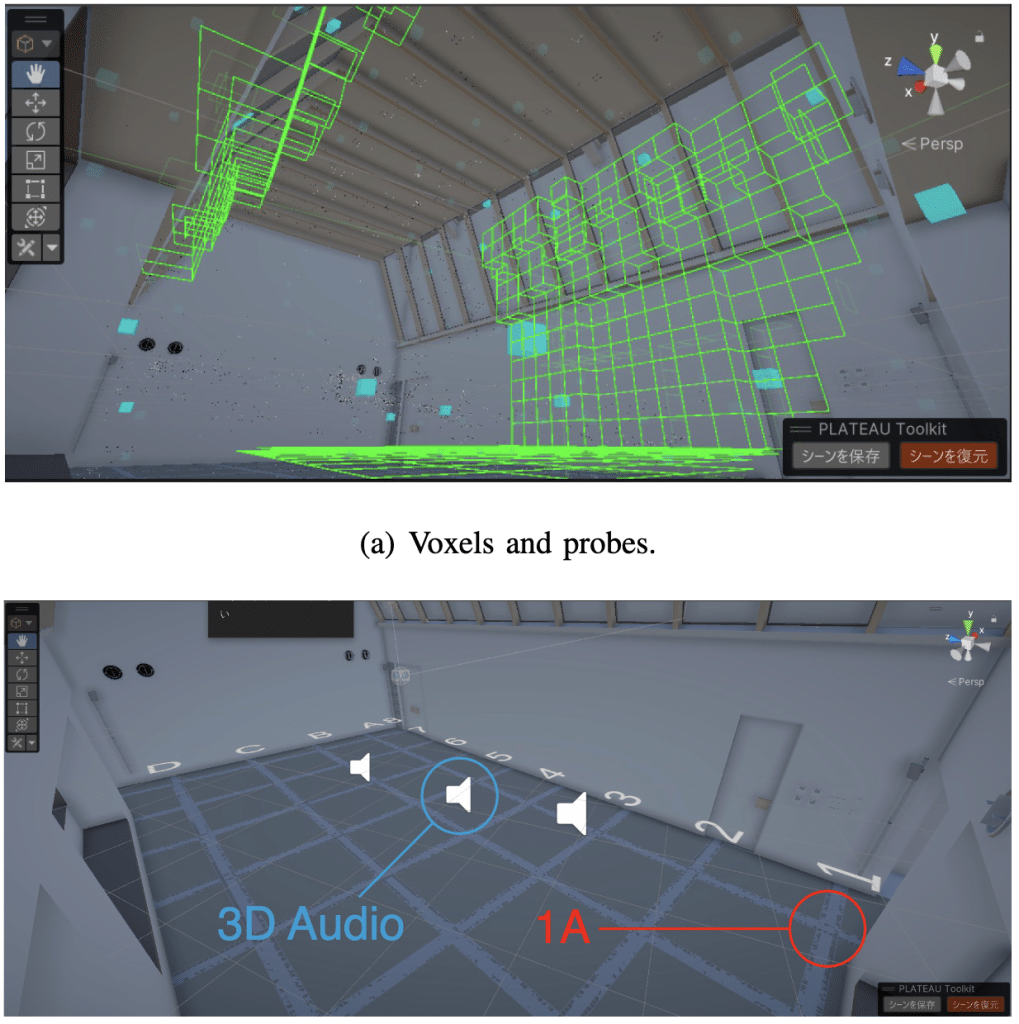
また、建物内部のデジタルツインに音響情報を加える試みとして、AR技術とスマートフォンを用いた3D音響可視化システムを実装しました。Visual Positioning System(VPS)による高精度な自己位置推定と、音源の空間配置との統合により、仮想空間上での没入的な音楽体験を実現しています。これは、従来のBIMでは扱われなかった“音の空間性”を、デジタルツインの中に取り込む新しいアプローチです。
さらに、時空間的に異質なデータ資産を一貫して管理・再利用可能にするため、セマンティクスを活用したメタデータスキーマとビューアを設計しました。このSemantic Digital Twinは、建物設備や人の動きなど多様なエンティティの動的挙動を統一的に表現でき、BIMベースデジタルツインの汎用性と相互運用性を飛躍的に高めるものです。本研究は、将来のスマートビルや都市インフラ、メタバース連携に向けた基盤技術として展開を続けています。
@inproceedings{Takada2024,
title = {Design of Digital Twin Architecture for 3D Audio Visualization in AR},
author = {Tokio Takada and Jin Nakazato and Alex Orsholits and Manabu Tsukada and Hideya Ochiai and Hiroshi Esaki},
doi = {10.1109/MetaCom62920.2024.00044},
year = {2024},
date = {2024-08-12},
urldate = {2024-08-12},
booktitle = {The 2nd Annual IEEE International Conference on Metaverse Computing, Networking, and Applications (MetaCom 2024)},
address = {Hong Kong, China},
abstract = {Digital twins have recently attracted attention from academia and industry as a technology connecting physical space and cyberspace. Digital twins are compatible with Augmented Reality (AR) and Virtual Reality (VR), enabling us to understand information in cyberspace. In this study, we focus on music and design an architecture for a 3D representation of music using a digital twin. Specifically, we organize the requirements for a digital twin for music and design the architecture. We establish a method to perform 3D representation in cyberspace and map the recorded audio data in physical space. In this paper, we implemented the physical space representation using a smartphone as an AR device and employed a visual positioning system (VPS) for self-positioning. For evaluation, in addition to system errors in the 3D representation of audio data, we conducted a questionnaire evaluation with several users as a user study. From these results, we evaluated the effectiveness of the implemented system. At the same time, we also found issues we need to improve in the implemented system in future works.},
key = {CREST},
keywords = {},
pubstate = {published},
tppubtype = {inproceedings}
}
@inproceedings{Furuta2023,
title = {Web-Based BIM Platform for Building Digital Twin},
author = {Satoru Furuta and Jin Nakazato and Manabu Tsukada},
url = {https://github.com/gutp-bim/ifcdata-management-systems/tree/main/viewer
https://youtu.be/mC_CXoSo2Mk
},
doi = {10.1109/DTPI59677.2023.10365476},
year = {2023},
date = {2023-11-07},
urldate = {2023-11-07},
booktitle = {3rd Annual IEEE International Conference on Digital Twins and Parallel Intelligence (DTPI 2023)},
address = {Florida, USA},
abstract = {Building digital twin (BDT) is utilized throughout the lifecycle of a building. It serves for efficient operations during the design and construction phases, and during the operational and maintenance phases, it’s used for asset management and as field maps for robots. Building Information Modeling (BIM), which contains both semantics and geometry data of building elements, holds promise as a data source for BDT. We have extracted four key technical challenges of the digital twin, particularly vital during the operational and maintenance phases: software, visualization, update, and real-scene reconstruction. Due to the exclusive and static nature of BIM, these challenges also pose significant issues in the context of BDT. To address these challenges, we designed and implemented a Web-based BIM platform. The implemented application shows not only geometry data but also semantics data, enables easy overlay with the latest indoor conditions, and provides updating functionality. The developed system is essential for the continuous operation of BDT in dynamic indoor environments. We evaluated the application through a questionnaire survey. },
keywords = {},
pubstate = {published},
tppubtype = {inproceedings}
}
@inproceedings{Inokuchi2023b,
title = {Semantic Digital Twin for interoperability and comprehensive management of data assets},
author = {Kazuma Inokuchi and Jin Nakazato and Manabu Tsukada and Hiroshi Esaki},
url = {https://www.researchgate.net/profile/Jin-Nakazato/publication/371903091_Semantic_digital_twin_for_interoperability_and_Comprehensive_Management_of_Data_Assets/links/649b13318de7ed28ba5ca665/Semantic-digital-twin-for-interoperability-and-Comprehensive-Management-of-Data-Assets.pdf},
doi = {10.1109/MetaCom57706.2023.00049},
year = {2023},
date = {2023-06-26},
urldate = {2023-06-26},
booktitle = {IEEE International Conference on Metaverse Computing, Networking and Applications (IEEE MetaCom 2023)},
address = {Kyoto, Japan},
abstract = {Fusion of the real and virtual worlds is essential for applying digital technology to the infrastructure of human life. A digital twin is one of the technologies that aim to integrate real and virtual space. It creates a digital world with high fidelity to reality by accumulating exhaustive information from sensors to improve simulation and prediction accuracy. However, traditional digital twins have data asset management challenges owing to the physical, temporal, and structural heterogeneity of their objects. In this paper, we propose two metadata schemas that leverage semantics to construct a designer-oriented digital twin. Moreover, we implemented a viewer that reproduced the office-like demonstration field to verify the application of the proposed ontology. The proposed method enables a generic description of the dynamic behaviors of any entity by integrating physical twins faithful to the real world with virtual models expected by designers. We compared the proposed ontologies with existing techniques, conducted user evaluations, and discussed possible approaches for further enhancements for widespread use.},
keywords = {},
pubstate = {published},
tppubtype = {inproceedings}
}
autonomous driving v2x
digital twins extended reality
digital twins
autonomous driving machine learning
machine learning v2x
autonomous driving v2x
extended reality