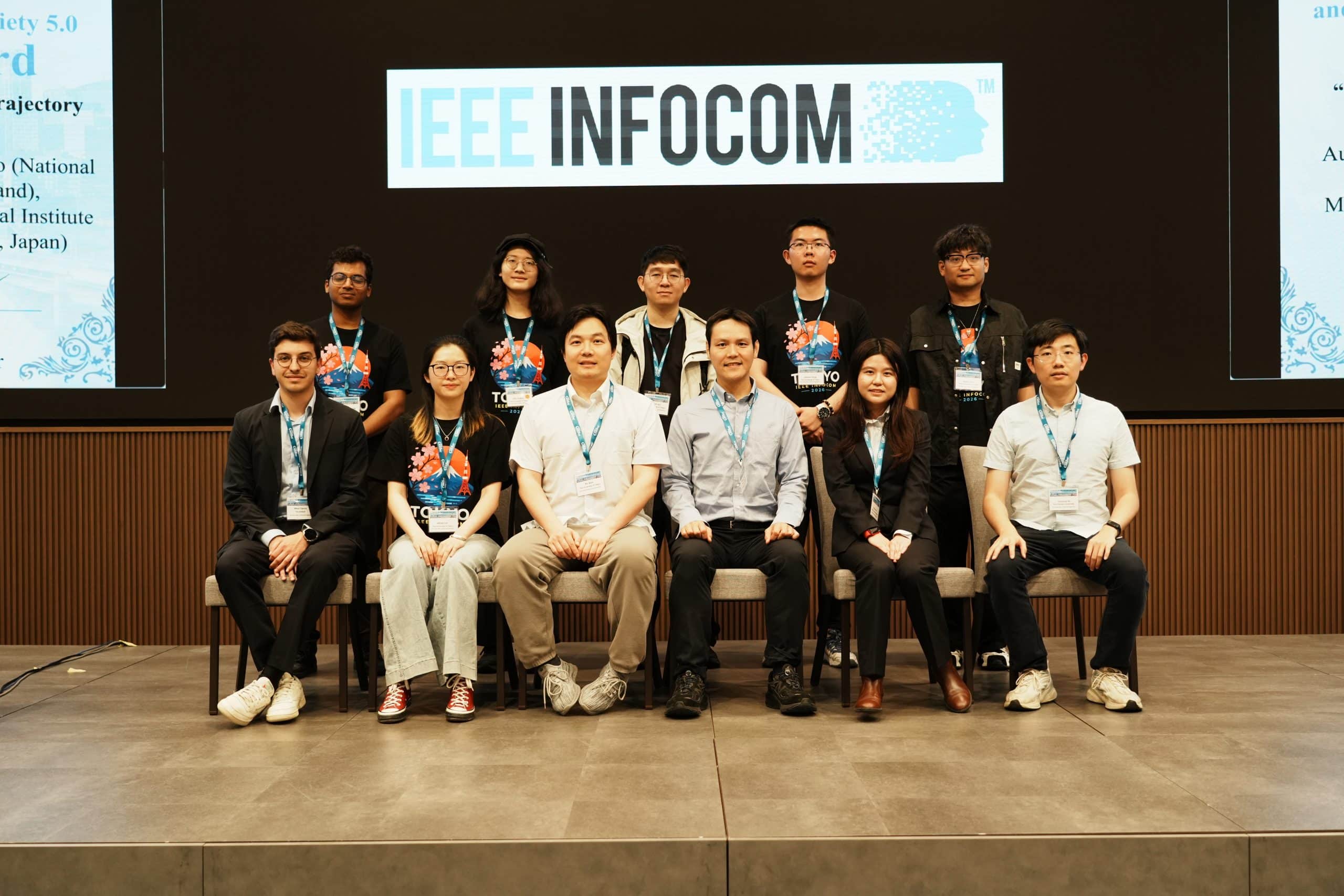
Tsukada Laboratory contributed to IEEE INFOCOM 2026, held at the Hilton Tokyo from May 18 to 21, 2026. IEEE INFOCOM is one of the most highly ranked international conferences on computer communications and networking, and this year marks its return to Japan for the first time in 29 years, bringing together more than 900 researchers worldwide.
Part 1. Main Conference: Local Arrangements Chair and Student Volunteers
Associate Professor Manabu Tsukada served as the Local Arrangements Chair of IEEE INFOCOM 2026, leading the on-site operations across the four-day program — venue, registration, social events, banquet, and logistics — in close collaboration with the IEEE Communications Society and the technical program committee.
To support this on-site operation, about ten student volunteers from Tsukada Lab also participated, assisting at the registration desk, in technical sessions, at the workshop and demo rooms, and at the welcome reception and banquet. For the students, it was a valuable first-hand experience of how a top-tier international conference is run, and an opportunity to interact directly with leading researchers from around the world.
Part 2. DOICT-IndSoc Workshop: Organization and Best Paper Runner-up Award
Tsukada Lab also co-organized the International Workshop on Fusion of Data, Operation, Information, and Communication Technology for Industry 4.0 and Society 5.0 (DOICT-IndSoc), held in conjunction with IEEE INFOCOM 2026. Associate Professor Manabu Tsukada served as the Lead General Chair, and Dr. Bo Qian (Project Assistant Professor at Tsukada Lab) served as the Lead TPC Chair, making an outstanding contribution to the technical program management. The workshop received 60 submissions and accepted 38 papers after peer review.
Tsukada Lab’s doctoral student Quanxi Zhou presented “Deep Reinforcement Learning for Automated Guided Vehicle Trajectory Planning in Industry 4.0,” which proposes a Sub-task Agent Triple Deep Q-Network (SA-TDQN) algorithm for distributed trajectory planning of AGVs in large-scale dynamic factory environments. The paper received the Best Paper Runner-up Award.
Xiaoyang He, a former visiting student, also had his paper “Beam-aware Kernelized Contextual Bandits for User Association and Beamforming in mmWave Vehicular Networks” accepted at the workshop, proposing the BKC-UCB algorithm that jointly optimizes user association and beamforming without relying on channel state information.
Publication