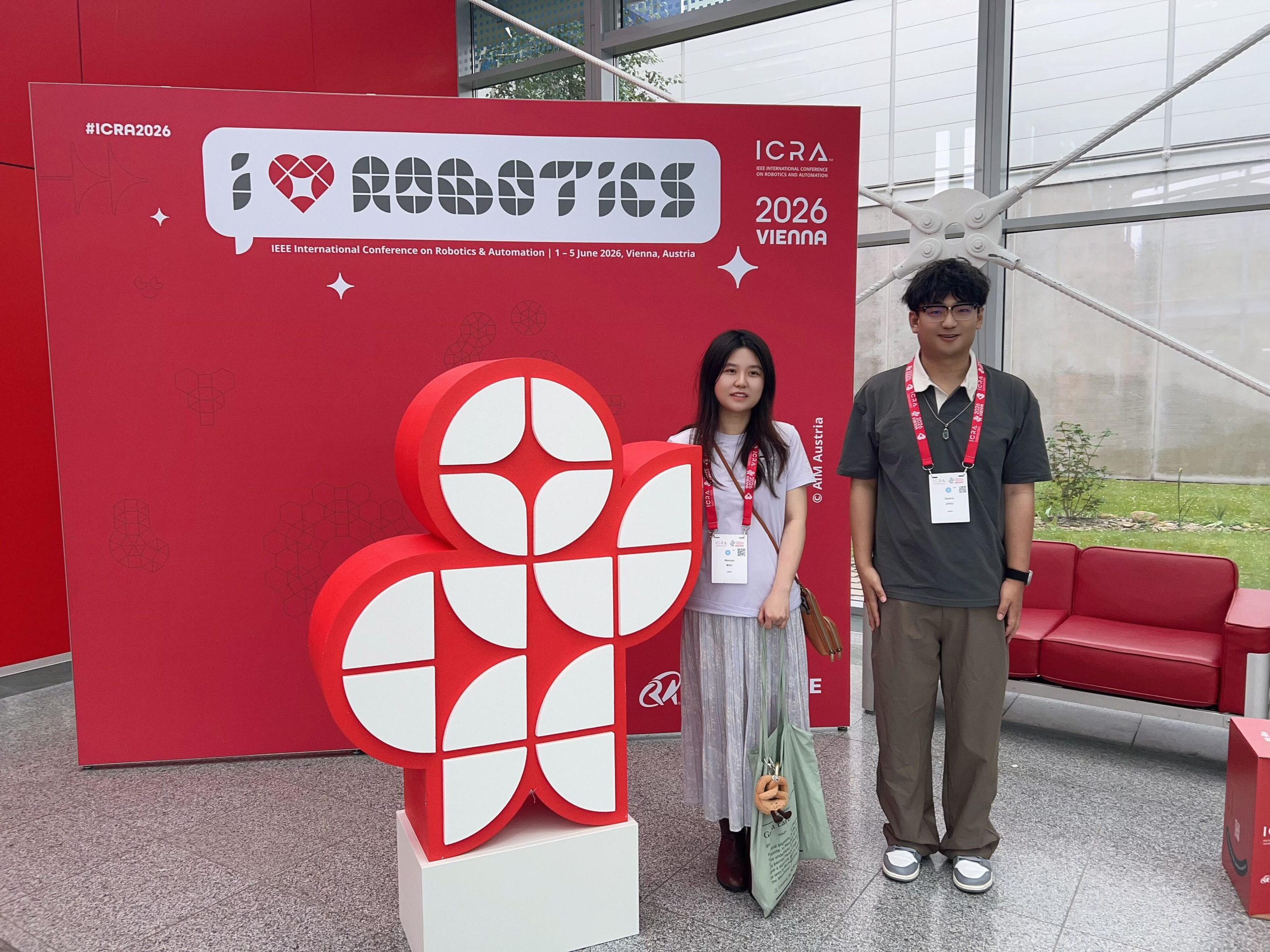
ICRA 2026 (IEEE International Conference on Robotics and Automation), held June 1–5 at Messe Wien, Vienna, Austria, was under the theme “Robots for All”. It lived up to its reputation as the largest robotics research conference in the world, and the Vienna setting made the experience all the more memorable. The city’s historic charm provided a fitting backdrop for discussions about the cutting edge of technology, with the grand coffee houses and imperial architecture offering a striking contrast to the autonomous systems and AI-driven machines filling the exhibition floors. The program was dense and inspiring — plenary and keynote sessions, contributed paper sessions, workshops, tutorials, forums, and a lively expo floor kept attendees constantly on the move. The conference also included a special Imperial Night, featuring a live concert, dance performances, and orchestral music in the magnificent palace.
Tsukada Lab’s D2 student, Quanxi Zhou, attended the conference, together with his collaborators, Wencan Mao, from the National Institute of Informatics, Japan, and Tomás Couso Coddou, from the National Center for Artificial Intelligence, Chile. They presented their paper, “Trajectory Planning for UAV-Based Smart Farming Using Imitation-Based Triple Deep Q-Learning”, in the Interactive Poster session Hall C, on June 4. This paper addresses the challenge of UAV trajectory planning in smart agriculture by framing it as a Markov decision process and proposing a novel imitation-based triple deep Q-network (ITDQN) algorithm — combining an elite imitation mechanism with a mediator Q-network — to enable UAVs to simultaneously perform weed detection, recognition, and wireless sensor data collection more efficiently than existing methods. Another highlight of this work is the international collaborations, spanning Japan, China, and Chile.
Tsukada Lab’s D3 student, Hanlin Wu, also attended the conference. He presented his paper, “Co3SOP: A Collaborative 3D Semantic Occupancy Prediction Dataset and Benchmark for Autonomous Driving”, in the Interactive Poster session Hall C, on June 3. This research tackles a key limitation of single-vehicle autonomous driving perception — namely occlusions, restricted sensor range, and narrow viewpoints — by introducing a collaborative dataset and benchmark that enables multiple agents to share complementary information for voxel-level 3D semantic occupancy prediction.
Another highlight of ICRA 2026 was the robot parade on June 4 — a vibrant procession that allowed visitors to witness the practical operational capabilities of diverse robotic platforms in real-time. Humanoid robots, competition entries, and industry showcases spilled across the halls of VIECON, with the parade drawing in much of the crowd of over 8,000 experts gathered from research, industry, and technology. Watching such a breadth of machines move through the space — from nimble-legged robots to robotic pandas and large manipulator arms — made the conference’s theme of “Robots for All” feel genuinely tangible, a reminder that what once lived only in lab papers is now walking, rolling, and racing right in front of you.
Attending ICRA 2026 in Vienna was a memorable experience, and Vienna’s elegant backdrop made the dense schedule of keynotes, paper sessions, and live robot competitions feel like something more than just another academic gathering.
Publication